
Trump's tariffs, falling shrimp prices, and fears of additional US levies, spark a crisis in Andhra Pradesh's politically vital aquaculture sector.

Net profit of 19 listed banks is likely to decline by 4 per cent year-on-year (Y-o-Y) for the quarter ended March (Q4FY25) mainly due to pressure on net interest margins (NIM) as a result of rate cut by the Reserve Bank of India (RBI), according to analysts' estimates. Additionally, loan growth is expected to further slowdown amid low demand in certain secured products, stress in the unsecured segment, and a high cost to deposit (CD) ratio across the system.

Securitisation - sale of loans to investors - by lenders, including banks and non-banking financial companies (NBFCs), crossed Rs 50,000 crore during the fourth quarter ended March 2025 (Q4F25). This is a tad higher than Rs 48,000 crore during the same period of FY24.

The pace of loan growth among public sector banks (PSBs) has seen a surge in the financial year 2024-25, and this is an exception to the overall moderation in bank credit during FY25. PSU banks' share in incremental credit rose to 57.3 per cent in March from 51.7 per cent a year ago, according to the Reserve Bank of India's (RBI's) Monetary Policy Report (April 2025).
The only silver lining in March's performance -- which otherwise dragged down the financial year's momentum -- was a 6 per cent year-on-year (Y-o-Y) growth compared to March of the previous year. This is largely due to incentives, festival-driven gains, and new launches.

According to an industry expert, companies such as Trident, Welspun India, Arvind, KPR Mill, Vardhman Textiles, Page Industries, Raymond, and Alok Industries stand to gain, as revenue from the US market accounts for 20-60 per cent of their earnings.
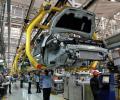
Auto parts exports from India may see a slight slowdown as US President Donald Trump's 25 per cent tariff could increase car prices for buyers by 8-25 per cent, thereby affecting demand, experts believe.

UPI topped Rs 24 trillion in value of transactions and 19 billion in volume for the first time after becoming operational in April 2016.

What transpired during that drive was one of the most compelling investment pitches made by an Indian state in decades.

The meltdown in Dalal Street that wiped out investor wealth to the tune of 44 trillion in 2025 also seems to be having a ripple effect on the country's vibrant automobile retail sales.

As auto major Mahindra & Mahindra (M&M) became the number two player in the retail passenger vehicle segment for the first time in February, powered by its new launches, the company is setting its sights on technology upgrades.

The gap between credit and deposit growth in the banking system is expected to decline sharply to 80 basis points (bps) in the next financial year from an average of 386 bps over the FY22-Q3FY25 period, according to rating agency India Ratings. This would be against the backdrop of sharp moderation in the incremental loan deposit ratio (LDR) of the Indian banking system to 85 per cent in February 2025 from 117-118 per cent in the same month of 2024.

Zetwerk Manufacturing, a $3.1 billion company in the contract manufacturing space, is planning to come up with an initial public offering within the next 15-24 months, a top company executive said on Saturday. The Bengaluru-based company aims to raise at least $500 million, targeting a valuation of around $5 billion.

'From the Indian perspective, young customers with more disposable income will also drive the growth.'

In 2024 alone, South India saw the highest rise in sales in the luxury segment, with Tamil Nadu reportedly registering a 19.3 per cent increase in premium car registrations from 2022-23

The gold loan portfolio of banks continued to show strong off-take with 76 per cent year-on-year (Y-o-Y) growth in January 2025 amid moderation in retail credit - especially in the unsecured credit segment - following increase in risk weights in November 2023. The gold loan pool had grown 17.4 per cent Y-o-Y in January 2024.

'I don't know when I will be able to access those funds.'

The average Indian works 46.7 hours per week, surpassing even China's 46.1 hours. In some sectors, the numbers are even more staggering.

'I believe that the overall demand for commercial vehicles will improve, even though there is a slowdown in the GDP.'

With nearly 100 launches and unveils, the Bharat Mobility Global Expo 2025, held in Delhi from January 17 to 22, made one thing clear to automobile enthusiasts: Electric vehicles (EVs) are the way ahead for the Indian auto market for years to come.
 © 2026 Rediff.com - Investor Information - Advertise with us - Disclaimer - Privacy Policy - Sitemap - Feedback - About us - Terms of use - Grievances